Walden 7 and the Prehistory of Algorithmic Design: Rule-Based Architecture Before Computation
Written by Ar. Darshi KapadiaPublished on 17 March 2026
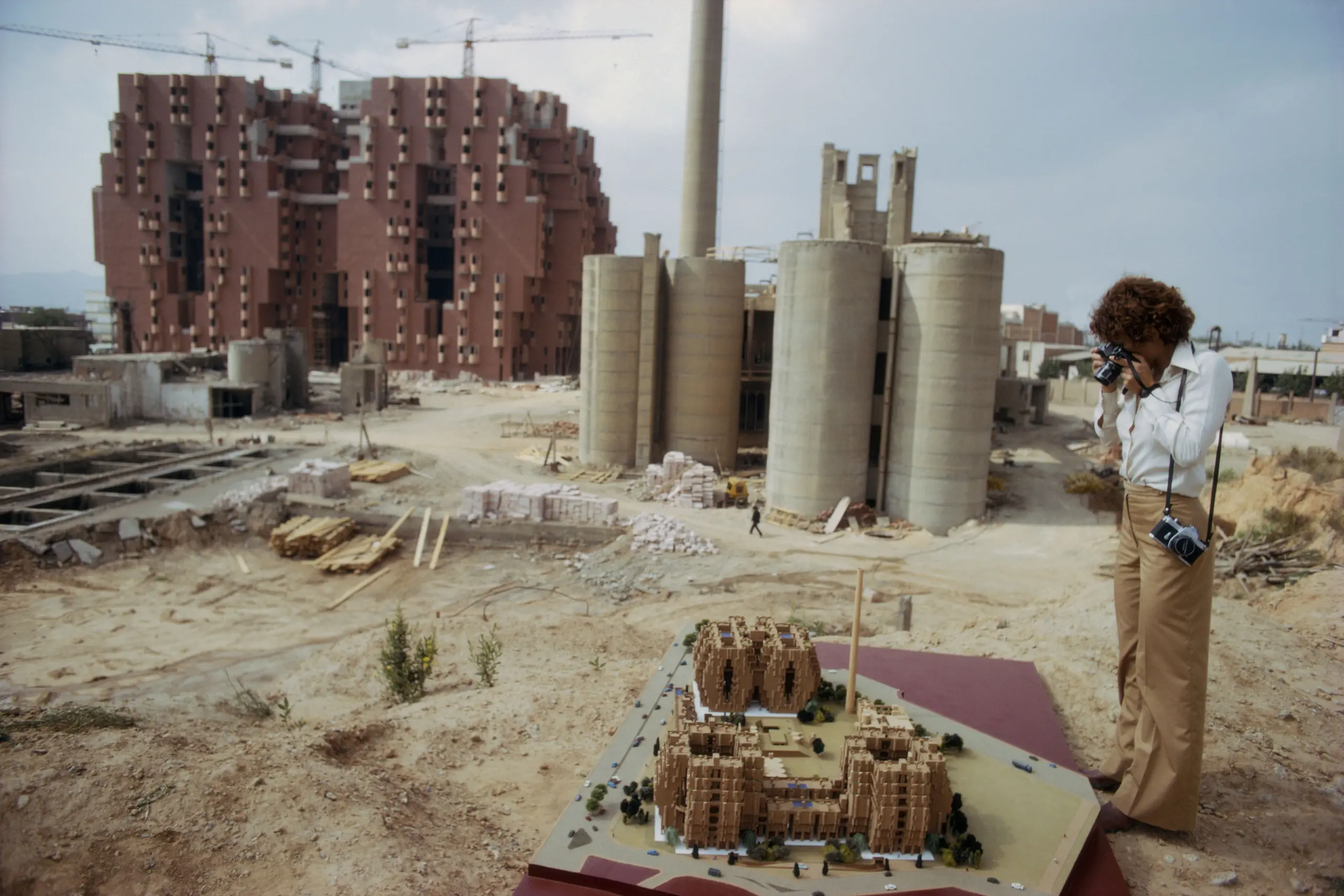
Ricardo Bofill’s Walden 7 (1975) occupies a distinctive position within late twentieth-century architectural discourse, often framed as a utopian housing experiment emerging from postwar critiques of modernist urbanism. However, when examined through the lens of algorithmic design, the project reveals a proto-computational logic that anticipates many of the principles now associated with digital and parametric practices. While developed prior to the widespread use of computational tools in architecture, Walden 7 demonstrates a rule-based, combinatorial approach to form-making that aligns closely with contemporary algorithmic thinking.
At the level of formal organization, Walden 7 is structured around a modular system composed of repetitive residential units. These units are not conceived as isolated entities but as elements within a larger generative framework. Through processes of aggregation, stacking, and interlocking, individual modules combine to produce a complex, multi-scalar spatial configuration. This methodology reflects a shift away from singular, top-down compositional strategies toward a bottom-up logic in which global form emerges from local interactions. In algorithmic terms, the project can be understood as the output of a finite set of rules governing adjacency, orientation, and repetition.
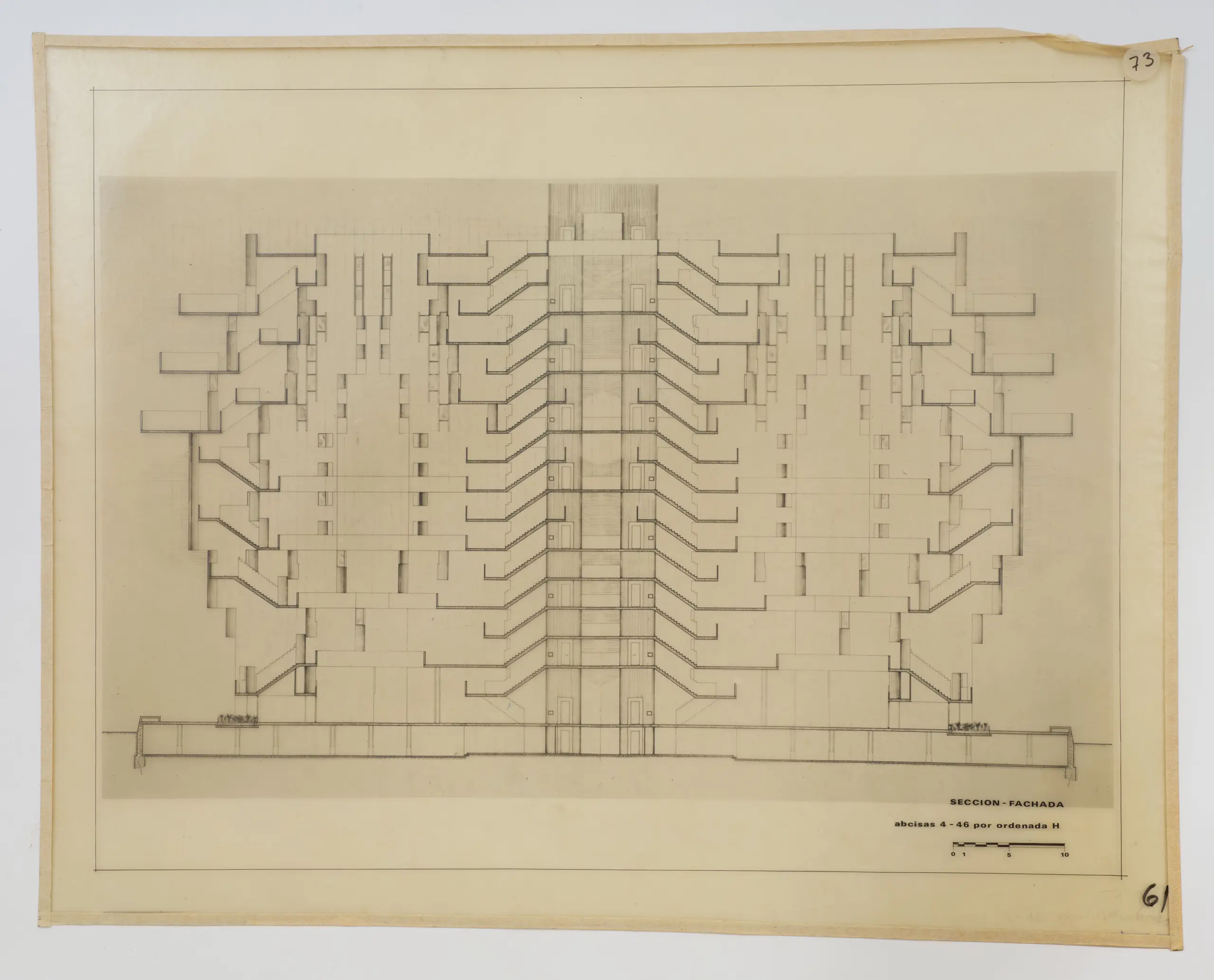
Such an approach foregrounds the importance of combinatorics in architectural design. The limited palette of unit types yields a multiplicity of spatial outcomes, ranging from compact interior corridors to expansive communal terraces and vertically articulated voids. These spatial variations are not explicitly designed as discrete moments but arise as emergent properties of the system. The notion of emergence—central to algorithmic design—captures how complex spatial and experiential conditions can result from the iterative application of simple generative rules. Walden 7, in this sense, operates less as a fixed object and more as a field condition produced through systematic variation.
The project’s circulation network further reinforces this interpretation. Rather than adhering to a hierarchical or axial organization, circulation in Walden 7 is distributed across a network of bridges, staircases, and elevated walkways. This networked configuration enables multiple pathways and points of connection, producing a non-linear spatial experience. From an algorithmic perspective, such a system can be analogized to graph structures, where nodes (residential units and communal spaces) are linked through edges (circulation paths). The absence of a singular organizing axis suggests a decentralized logic, one that prioritizes connectivity and multiplicity over clarity and control.
.dede5fb7.webp)
Importantly, Walden 7 extends its rule-based logic beyond formal and spatial concerns into the social domain. Conceived in dialogue with B.F. Skinner’s Walden Two, the project was intended as a model for collective living in which architectural form could actively shape patterns of social interaction. Shared courtyards, visual permeability, and interwoven circulation routes were designed to foster community engagement and incidental encounters. From an algorithmic standpoint, this introduces a behavioral dimension: the architectural system not only generates spatial configurations but also conditions potential social dynamics. In this sense, Walden 7 can be read as an early exploration of architecture as a socio-spatial algorithm, scripting possibilities rather than prescribing fixed outcomes.
Nevertheless, the project also exposes inherent tensions within system-based design approaches. While the combinatorial logic enables formal richness and spatial diversity, it also introduces practical challenges related to maintenance, accessibility, and long-term adaptability. The complexity that emerges from the system can produce inefficiencies and ambiguities, particularly when interfacing with the contingencies of everyday use. This highlights a critical issue that persists in contemporary algorithmic design: the gap between generative elegance and lived reality. Systems that perform coherently at the level of abstraction may encounter friction when subjected to the unpredictability of human behavior and material constraints.
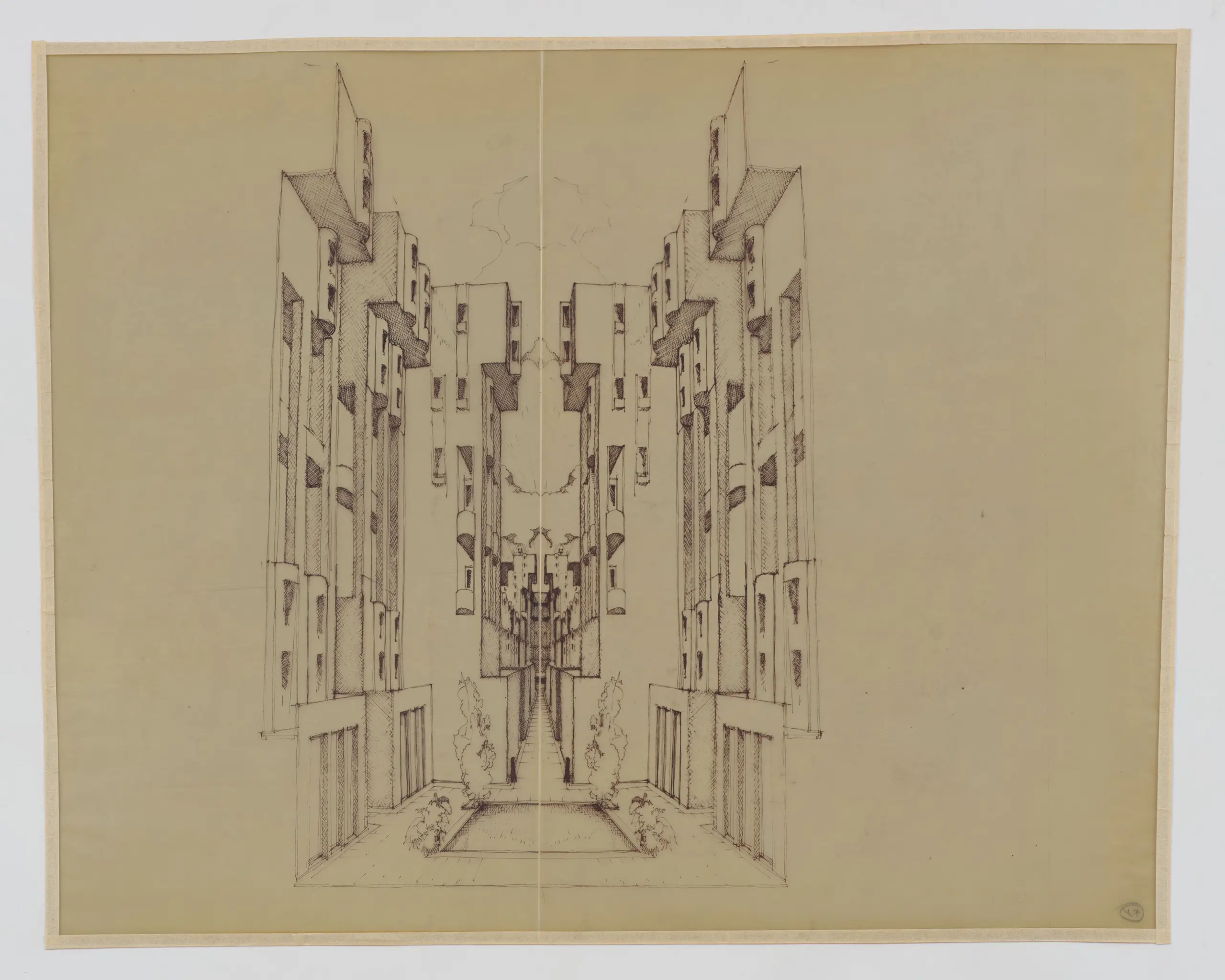
Aesthetically, Walden 7’s fragmented massing and emphatic coloration further underscore its systemic character. The building reads as an aggregation of discrete elements rather than a unified volumetric object, anticipating the visual language of later digital and parametric architectures. The repetition of modular components produces a “voxel-like” effect, in which the legibility of the part-to-whole relationship becomes a central compositional feature. This formal expression reinforces the underlying generative logic, making the process of assembly perceptible within the built form.
Reconsidered through the lens of algorithmic design, Walden 7 can thus be understood as a pre-digital exploration of rule-based architectural thinking. It demonstrates that the conceptual foundations of algorithmic design—modularity, iteration, emergence, and system-driven variation—were already present in analog practices prior to the advent of computational tools. What distinguishes contemporary algorithmic approaches is not the invention of these principles, but their amplification through digital computation, which enables greater precision, scalability, and responsiveness.
In this context, Walden 7 serves as both a historical precedent and a critical reference point. It bridges the gap between analog and digital paradigms, illustrating how architectural systems can generate complexity while simultaneously revealing the limitations of such approaches. As algorithmic design continues to shape contemporary practice, revisiting projects like Walden 7 offers valuable insight into the enduring relationship between rules, form, and human experience.